September 2025 – Bristol, UK
What is headshaking?
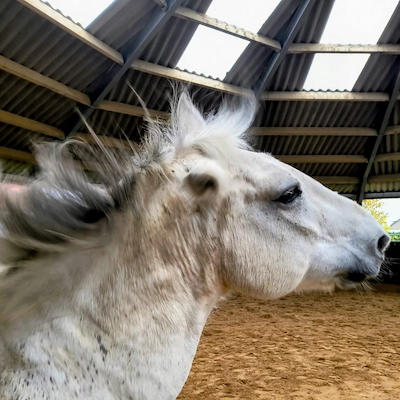
Headshaking is a condition in horses characterized by sudden, involuntary head tossing, unusual movements of the head and neck, and rubbing or irritation around the nose. Affected horses often show signs of pain and stress. According to a survey conducted by the Free University of Berlin, headshaking affects about 6% of horses, making it one of the most common equine health issues [1].
How is headshaking diagnosed?
Once other possible causes such as dental problems, musculoskeletal issues, or eye conditions have been ruled out, attention turns to the trigeminal nerve – the nerve responsible for facial sensation. What has long been recognized in humans has also been confirmed in veterinary medicine: studies show that in affected horses, this nerve reacts far more sensitively than in healthy animals. This hypersensitivity means that even the slightest stimuli can trigger pain responses.
In practice, diagnosing headshaking can be challenging. So far, involvement of the trigeminal nerve can only be confirmed through exclusion of other conditions or specialized examinations carried out under general anesthesia. At present, there is no simple, non-invasive method available for use in awake horses. The exact causes and mechanisms behind the headshaking syndrome also remain only partially understood.
How is headshaking in horses treated?
Conventional therapies such as masks, nets, or medication only help about 20–50% of affected horses. A more recent approach is neuromodulation, where the trigenimal nerve is specifically calmed using electrical impulses. This is currently done with so-called PENS therapy (percutanous electrical nerve stimulation), in which mild electrical currents of varying frequencies are applied under the skin near the nerve.
As an alternative, acupuncture or electro-acupuncture may be used, though research in this context is still limited. In electro-acupuncture, fine needles are inserted and gently stimulated with small electrical currents. The aim is to calm the hypersensitive trigenimal nerve and reduce pain signals.
PENS therapy is offered mainly at specialized clinics. While it is technically more complex, electro-acupuncture has the advantages of easier application, lower cost, and practical usability.
Latest findings
A recent study from the Royal Veterinary College in England investigated the effectiveness of electroacupuncture in 42 horses with headshaking and compared it to PENS therapy [2]. About two-thirds of the treated horses showed clear improvement, and in one-third the symptoms disappeared completely. Equally noteworthy, the method was very well tolerated and caused hardly any side effects.
Although the study did not include control or placebo groups and the number of participants was limited, the findings are encouraging. Electroacupuncture – and acupuncture more generally – may therefore offer a promising option to support horses with headshaking.
Is your horse struggling with headshaking and previous treatments haven’t worked? I’ll be happy to advise you!
References
- Electroacupuncture as a treatment for suspected trigeminal nerve-mediated head-shaking in 42 horses
B. Dunkel, G. L. Hildon, K. M. Coumbe, E. Busuttil, D. von Schweinitz, S. Devereux
https://doi.org/10.1111/eve.14135 - Fragebogenstudie zur Erstellung eines Gesundheitsstatus von Pferden in Deutschland. Freie Universität Berlin. Ljungberg, A. (2024).
Pic: With kind permission of N. Wittke