What is Librela?
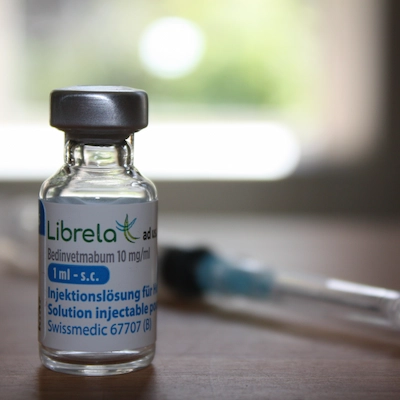
Librela® is an injectable pain medication for dogs, developed for the treatment of joint pain associated with osteoarthritis. It contains the active substance bedinvetmab, a so-called monoclonal antibody – a protein molecule that, in the case of bedinvetmab, blocks a specific messenger involved in pain signaling [1]. Treatment is given once a month as a subcutaneous injection and is considered to be particularly well tolerated – even in older dogs that often cannot take other medications. For cats, the product is approved under the name Solensia®.
Monoclonal antibodies originate from human medicine, where they are for example used in the treatment of cancer or autoimmune diseases. The antibody in Librela binds in animals to the so-called nerve growth factor (NGF).
NGF is a natural growth factor that plays an important role in the development and protection of nerve cells, particularly during embryonic development. In adult animals, especially in older dogs with osteoarthritis, NGF also contributes to the generation of pain. The active substance in Librela binds to this messenger and prevents pain signals from being transmitted. However, it does not cure the underlying disease – osteoarthritis – it only alleviates its symptoms. The substance was developed by Zoetis and has been authorized since November 2020 in Europe [2] and, following approval in Australia [3], since May 2023 also in the United States [4]. Since its market launch, more than 28 million doses of Librela have been administered worldwide – a commercial success and an indication of its broad and successful use in practice.
The active substance offers clear advantages, particularly in the treatment of chronic pain, as conventional drug therapies carry a high risk of intolerance and long-term side effects, especially affecting the kidneys and liver. In this context, the medication has received strong positive attention from the professional community since its introduction.
Critics
At the same time, reports have emerged describing dogs that experienced serious side effects during treatment, ranging from neurological symptoms to a rapid worsening of existing joint disease. This has fueled considerable uncertainty among pet owners and prompted negative headlines [5].
The mechanism of bedinvetmab has its roots in human medicine, where anti-NGF antibodies were developed in the early 2000s for the treatment of chronic pain, such as osteoarthritis and back pain. The expectation was that it would provide effective pain relief without the risks associated with traditional analgesics. Yet clinical trials repeatedly revealed cases of rapidly progressive osteoarthritis (RPOA), in which joints deteriorated irreversibly within only a few months – a pattern not typically seen in the natural course of the disease [6], [7]. In response, the U.S. Food and Drug Administration (FDA) imposed a two-year clinical hold on all anti-NGF agents in 2012. Even after research resumed under stricter conditions – including lower doses, prohibition of concomitant conventional painkillers, and tighter patient selection – the risk persisted. To this day, the underlying mechanism remains unclear.
A recent investigation from the United Kingdom reviewed safety reports concerning Librela [8]. The researchers examined thousands of entries in the European adverse event database and looked in greater detail at the medical records of 19 treated dogs. In these cases, unusually rapid and severe joint changes were observed – including fractures, luxations, and a marked acceleration of osteoarthritis. An expert panel considered a causal link with treatment to be likely. The authors also emphasized, however, that the number of cases was very small and does not demonstrate that all dogs receiving Librela are at such risk. The manufacturer Zoetis has rejected the findings, pointing to its own data from millions of administered doses in which such dramatic outcomes were not confirmed. At the same time, the European Medicines Agency (EMA) has required Zoetis to conduct a detailed safety analysis and to submit the results by September 2025 [9].
Context
As the authors themselves note and in my view as a specialist in epidemiology, this single recent study is not sufficiently robust to establish a clear causal link. Such a conclusion would require a far more rigorous study design and a substantially larger number of participants selected through a strictly defined process. Nevertheless, in the con text of reports from veterinarians, anecdotal accounts from colleagues in practice, and the history of the development of Librela, it does provide indications that this adverse effect can indeed occur.
Caution is especially warranted with anecdotal, non-scientific reports, since older animals are naturally prone to developing various conditions. The fact that such illnesses occur while a dog is receiving Librela does not in itself establish a causal relationship.
Despite the criticism, it should not be overlooked that Librela is still a relatively new product and that the recording of adverse events is often expanded in the first years of use as new information emerges. The fact that rapidly progressive osteoarthritis was not identified prior to approval suggests that this is a very rare phenomenon. Careful communication and balanced decision-making are therefore essential – but panic or blanket rejection, as is sometimes seen, are not justified. Despite these and other potential side effects, Librela has provided relief to countless patients and improved their quality of life in their later years. This is often forgotten in the debate: negative effects tend to attract more attention than positive outcomes, which creates a distorted picture. What must remain clear, however, is that untreated osteoarthritis pain severely compromises an animal’s quality of life, while the therapeutic options available remain limited.
Conclusion
Ultimately, the decision for or against Librela means weighing a well-documented and substantial benefit against a comparatively low risk – recognizing that absolute safety, as with other conventional treatments and indeed with almost every aspect of life, does not exist.
If you wish to learn more about alternatives or complementary options for managing chronic pain in your animal, I would be happy to advise you.
References
- European Medicines Agency (EMA). (n.d.). Librela: EPAR – Veterinary medicines. Retrieved August 17, 2025, from https://www.ema.europa.eu/en/medicines/veterinary/EPAR/librela
- European Medicines Agency (EMA). (n.d.). Librela – veterinary product information. Retrieved August 17, 2025, from https://medicines.health.europa.eu/veterinary/de/600000001761
- Australian Pesticides and Veterinary Medicines Authority (APVMA). (2022, October). Veterinary Medicines Regulatory Newsletter. Retrieved August 17, 2025, from https://www.apvma.gov.au/news-and-publications/newsletters/veterinary-medicines-regulatory-newsletter-october-2022
- U.S. Food and Drug Administration (FDA), Center for Veterinary Medicine. (2023, May 5). FDA approves first monoclonal antibody for dogs with osteoarthritis pain. Retrieved August 17, 2025, from https://www.fda.gov/animal-veterinary/cvm-updates/fda-approves-first-monoclonal-antibody-dogs-osteoarthritis-pain
- Rückert, R. (2023, September 21). Librela-Paranoia, schlechter Journalismus, mal wieder Social-Media-Hysterie. Blog post. Retrieved August 17, 2025, from https://www.ralph-rueckert.de/blog/librela-paranoia-schlechter-journalismus-mal-wieder-social-media-hysterie/
- Hochberg, M. C. (2015). Serious joint-related adverse events in randomized controlled trials of anti-nerve growth factor monoclonal antibodies. Osteoarthritis and Cartilage, 23(Suppl. 1), S18–S21. https://doi.org/10.1016/j.joca.2014.10.005
- Hochberg, M. C., Carrino, J. A., Schnitzer, T. J., Guermazi, A., Walsh, D. A., White, A., et al. (2021). Long-term safety and efficacy of subcutaneous tanezumab versus nonsteroidal anti-inflammatory drugs for hip or knee osteoarthritis: A randomized trial. Arthritis & Rheumatology, 73(7), 1167–1177. https://doi.org/10.1002/art.41674
- Farrell, M., et al. (2025). Musculoskeletal adverse events in dogs receiving bedinvetmab (Librela). Frontiers in Veterinary Science, 12, Article 1581490. Published May 9, 2025. https://doi.org/10.3389/fvets.2025.1581490
- European Medicines Agency (EMA). (2025, July 19). Meeting highlights from the Committee for Veterinary Medicinal Products (CVMP), 15–17 July 2025. Retrieved August 17, 2025, from https://www.ema.europa.eu/en/news/meeting-highlights-committee-veterinary-medicinal-products-cvmp-15-17-july-2025
Pic: VetDynamics